The Life and Opinions of Tristram Shandy, Gentlemen
by Laurence Sterne
Published 1767 601 pagesGosh, what do I say about The Life and Opinions of Tristram Shandy? A book that people have been reading for two hundred and fifty years.
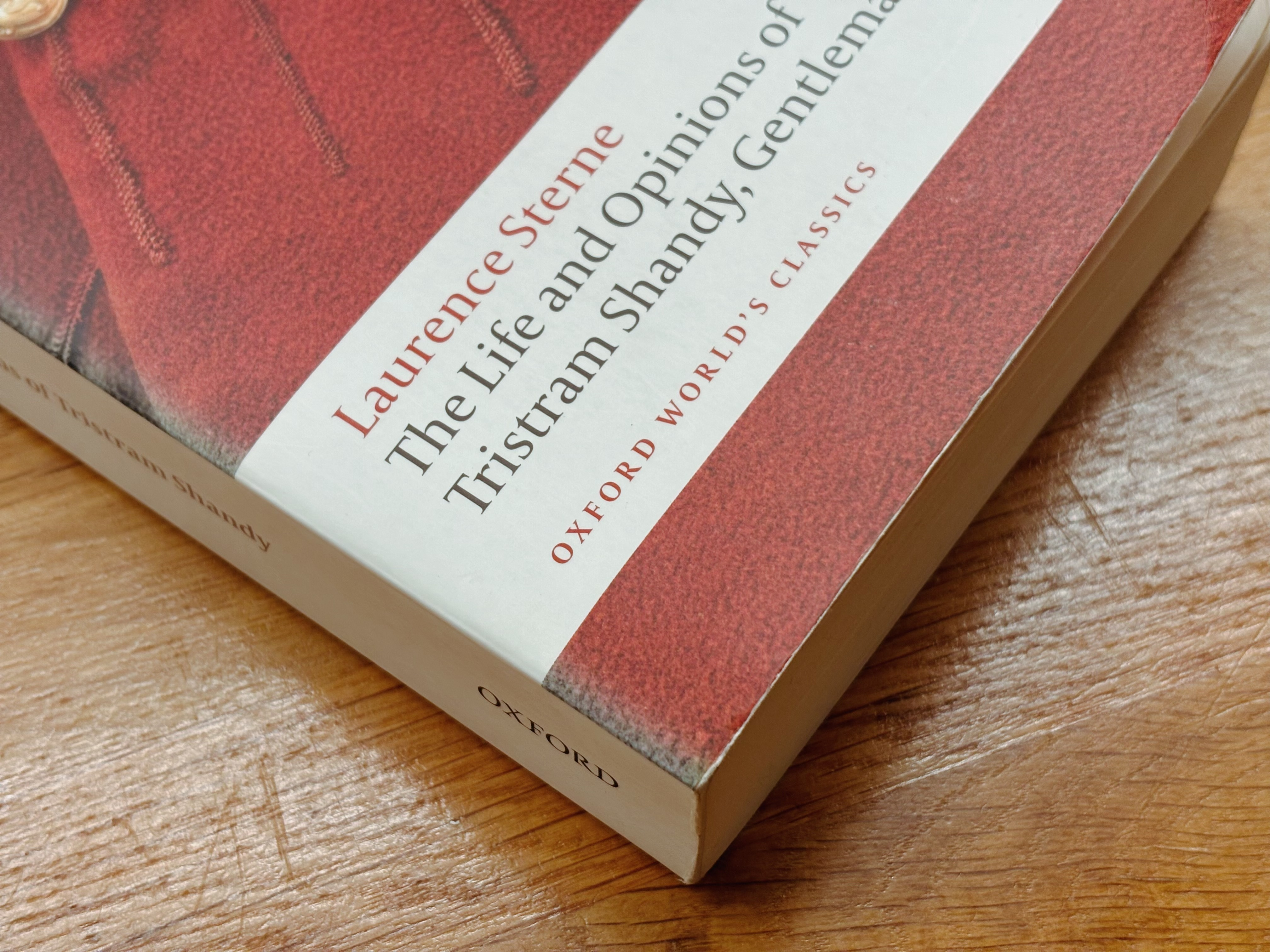
I picked this up on the force of a placement on some Top XXX Books posted on The Guardian, maybe? I’d tried to read it a couple of years ago on Kindle but the version that I downloaded was really poorly formatted and the whole thing put me off. The copy I eventually picked up off World of Books online for two quid + s&h evidently had sat unread and untouched on someone’s shelf for yonks: the corners were crisp and square and uncurled by rough use in backpacks, and the spine was unbroken and sunbleached. I think that this was probably an aspirational purchase for whoever owned this book before me; I would ensure it would not be so again.
I will tell you that Tristram Shandy is an eminently easy book to read and a difficult book to finish. Chapters are nice and short, and Sterne sort of wanders from topic to topic so you never really build up much context: in this way the book is very forgiving of short sessions.
That of all the several ways of beginning a book which are now in practice throughout the known world, I am confident my own way of doing it is the best—I’m sure it is the most religious—for I begin with writing the first sentence—and trusting to Almighty God for the second.
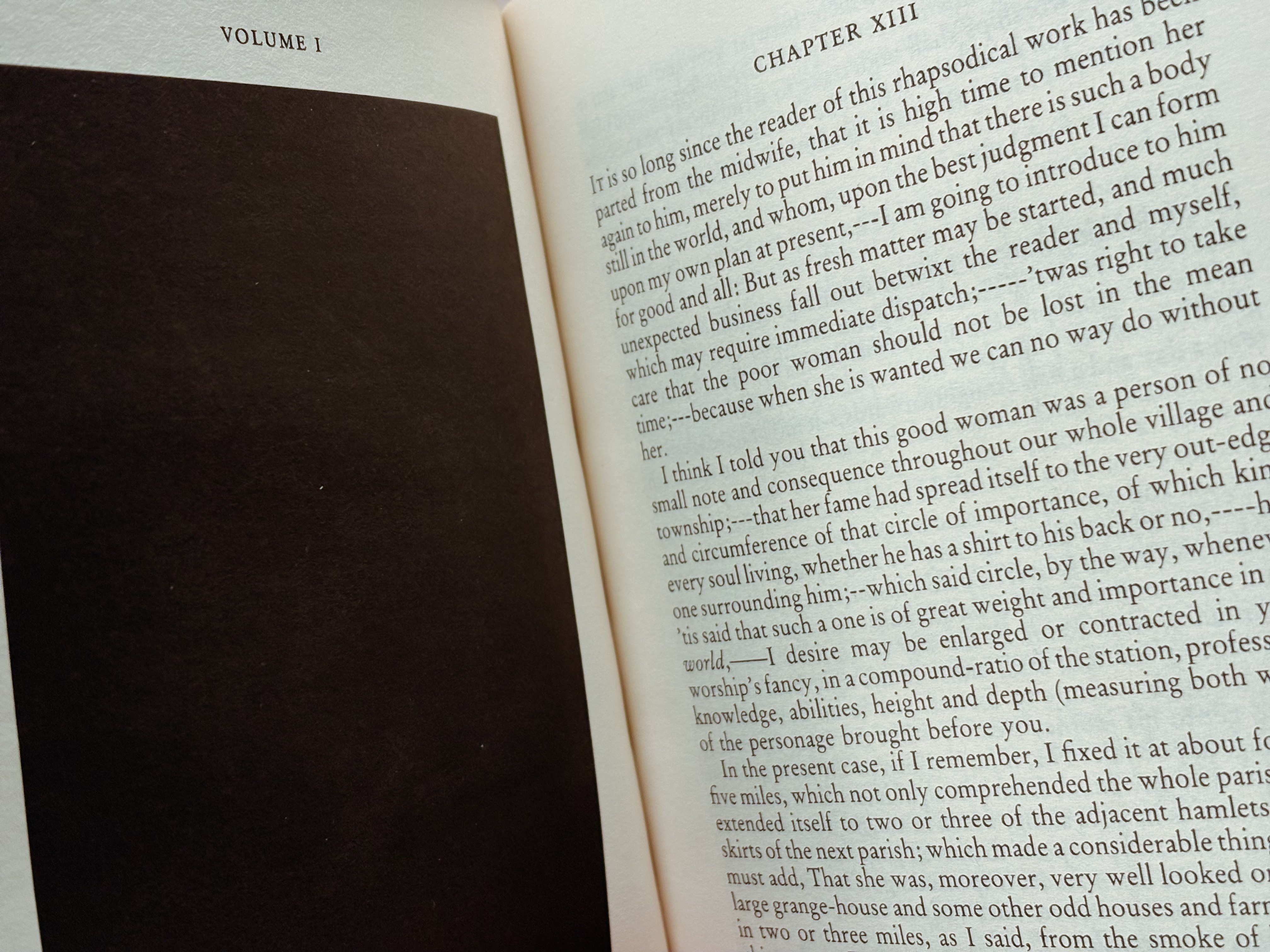
It is however intensely referential so woe be to you if you don’t have Explanatory Notes at the end of your edition (mine had 61 pages in 8pt). I kept two bookmarks in as I made my way through the book: one to keep my place in the story and one to keep my place in the Explanatory Notes. In certain places the context is indispensible (see e.g. for a long section written in badly polished French about prenatal baptism) — but Sterne has a sort of galloping cadence powered by em dashes that doesn’t lend itself to pausing and flipping through pages a few times every chapter. If I felt myself on a roll I’d just let my eyes roll over a footnote reference and just go with the flow, and then go and catch up on the footnotes at the end of the chapter. Or read a whole chapter’s footnotes first in an attempt to preload my mental cache with the requisite context (to middling success).
Indeed I found that going with the flow was the better reading strategy. Sterne — or rather, Shandy — wanders away from whatever he’s trying to say so frequently that I felt myself more often than not carried along without much understanding quite what was being got at — and then picking the thread back up again when I could parse what was going on. I don’t think I missed anything good. I suspect that Sterne scholars would disagree.
Pacing was also hard to get a bead on. I’m used to books boiling up to a fever, but I felt here that Sterne petered out after the first four volumes. This is probably a function of Sterne’s actual release schedule — releasing volumes at a time, rather than the whole omnibus. But it’s clear that in the beginning he was very excited about the project, and I could feel that excitement, palpably. I wasn’t surprised to here that he self-financed the first two volumes. The page bursts with life. Once Tristram’s been born and (famously) circumcised, however, I felt that the energy started to wane. I didn’t care much for Tristram’s adventures in France — they felt like a different book plopped in the middle of this one (which I think they were?). The wooing of the Widow Wadman at the end picked the thread back up, especially the central misunderstanding about how and where Toby was injured — so we ended on a good note.
I did struggle to find my rhythm, though! I was never bored, but I never really felt the urge to pick the book back up and find out what happened next. I would compare it to running a very long distance: you never lack for new, interesting things to look at, but the whole thing is a bit of a drain and at some point you get a bit bored. You won’t regret having done it, and you will recall it as a good experience, but you’ll wonder whether it was worth it: whether you, uh, maybe should have not run such a long distance.